


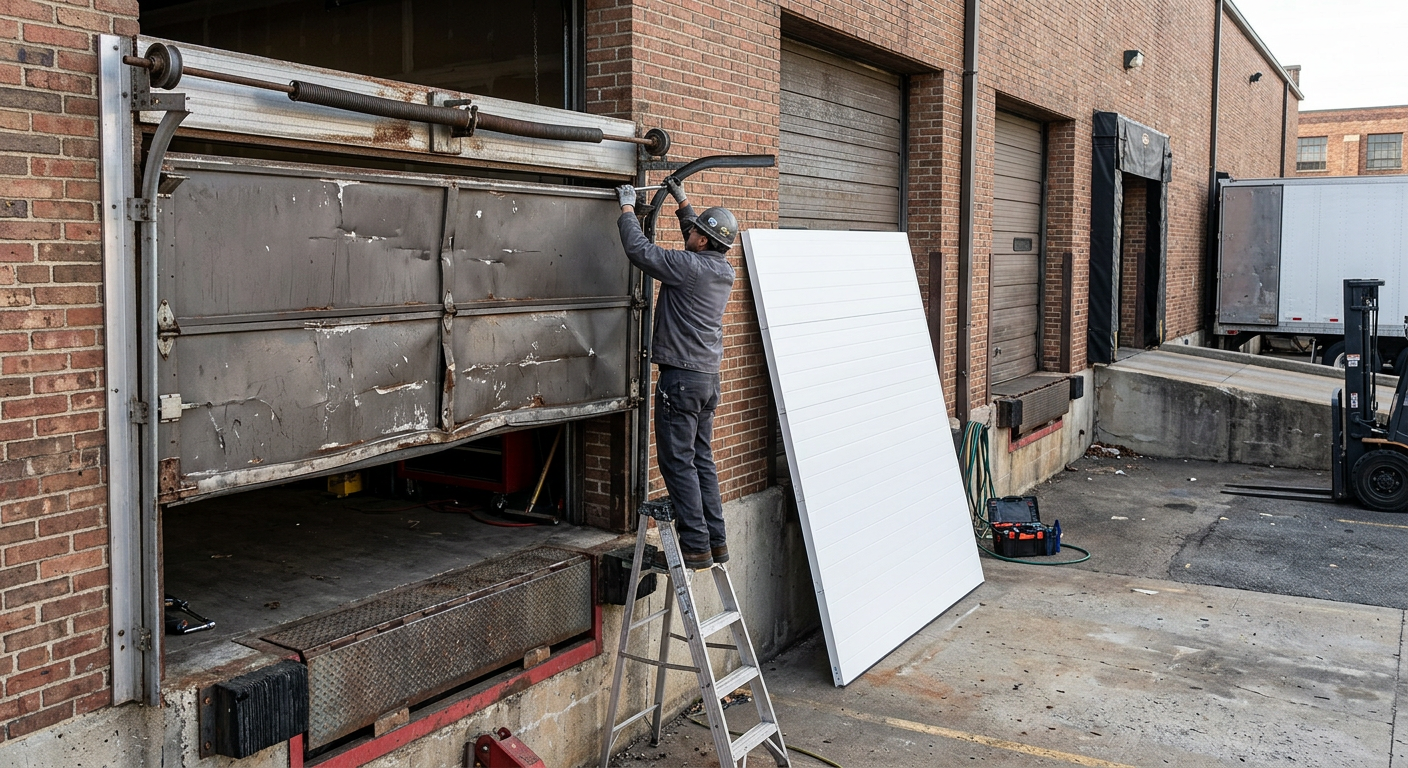
Commercial garage door replacement is different from new installation — it's removing an existing door (often badly damaged, end-of-life, or non-code-compliant) and installing a replacement at an active commercial facility. The complexity comes from the existing facility — coordinating around active business operations, protecting the opening during the swap, integrating with existing operators or upgrading them, and matching or upgrading the replacement door's specifications to current needs.
Who Needs This Service?
- Existing commercial door has been repeatedly repaired and now requires another major repair
- Insurance or warranty company has totaled the existing door after damage
- Facility is upgrading from standard to high-speed for traffic flow
- Energy efficiency upgrade (uninsulated to insulated, better R-value)
- Fire marshal requires fire-rated replacement
- Door size needs to change (wider, taller for new equipment)
- End-of-life door at apartment/parking facility with high cycle counts
What's Included
- On-site assessment and replacement specification
- Removal and disposal of existing door
- Frame, hardware, and panel installation
- Operator integration (or new operator)
- Safety device commissioning (photo eyes, reverse, etc.)
- Opening secured during swap
- Documentation and warranty registration
- Written quote, COI on request
Our Process
- 1
On-site assessment — measure opening, identify existing operator and integration, recommend replacement door specification
- 2
Written proposal — full replacement quote including removal, disposal, new door, and installation
- 3
Schedule coordination — work around facility operations, including weekend or after-hours options
- 4
Removal — old door, frame, hardware removed and hauled away
- 5
Installation — new door, frame, and hardware installed; opening sealed during work
- 6
Commissioning — operator integration, safety device verification, written documentation
What This Service Costs
Final pricing is provided in writing after a free on-site consultation. Cost depends on door size, material, insulation, window options, hardware, and any required structural prep — we walk through the options with you and confirm the scope before any work is scheduled.
What Commercial Replacement Involves
Replacement at an active commercial facility is a project, not a service call. The job starts with on-site assessment to confirm replacement scope, measure the opening accurately, identify whether the existing operator stays or gets replaced, and verify any code requirements (especially fire-rated separations).
Most commercial replacement work happens because: the existing door is at end-of-cycle-life (springs, cables, panels deteriorating despite repairs), the existing door has been damaged beyond economical repair (forklift impact, vehicle hit, storm damage), the facility's needs have changed (need higher cycle count, better insulation, faster speed, or higher security), or the door is non-code-compliant and replacement is required.
Removal and installation typically happen the same day on standard sectional and rolling steel doors. Larger or specialty doors take longer. We secure the opening during the swap so the facility is not exposed to weather or unauthorized access.
Brands We Replace Most Often
Across Evansville, Newburgh, Henderson KY, Boonville, and the broader Indiana, Kentucky & Illinois we replace existing commercial doors with whatever brand best matches the application — not whatever brand a single distributor pushes. The most-installed replacement lines on our quotes:
Clopay Commercial
Insulated and non-insulated sectional commercial — the most-quoted sectional replacement line in the region.
Wayne Dalton Commercial
Heavy commercial sectional and rolling steel replacements at distribution and fleet facilities.
Cookson
Rolling steel and fire-rated rolling replacements at warehouses, retail, and code-driven separations.
Cornell
Heavy commercial rolling steel and security grille replacements at industrial and retail.
Overhead Door (Thermacore, FireKing)
Insulated sectional and fire-rated rolling. Wide commercial deployment.
Rytec / Albany
High-speed industrial replacements at distribution and food-grade facilities upgrading from standard sectional.
Hörmann
Commercial sectional and high-speed replacements at higher-spec industrial sites.
Raynor / Amarr / C.H.I.
Mid-commercial sectional replacements at fleet shops, auto bays, and light industrial.
When Repair No Longer Makes Sense
- Multiple panels damaged across the door height — single-panel replacement is no longer cost-effective.
- Cumulative repairs over the past 12 months approach 50% of replacement cost.
- Operator and door both at end-of-life simultaneously — replace together for one mobilization.
- Insurance carrier has totaled the door after major damage.
- Code requirements have changed — fire rating now required, or higher security needed.
Repair vs. Replace Decision
Our default is repair. Most commercial doors have decades of useful life with appropriate maintenance and targeted parts replacement. Springs, cables, panels, rollers, and operators are all serviceable items.
We recommend replacement when the math no longer favors repair — when forecast 12-month repair costs approach replacement cost, when major structural damage has occurred, when the door's specification no longer matches the facility's use, or when code compliance requires a different door type. We give you a straight assessment with both options in writing.
Talk to a real local technician — free written quote after on-site inspection.
Call 812-454-5711Why Indiana, Kentucky & Illinois Businesses Choose River City
We work around your operations, not against them. Same crew handles removal AND installation — single accountability. Old door disposal included in the quote. Opening secured during the swap (typically same-day). Direct communication with facility manager throughout the project.