


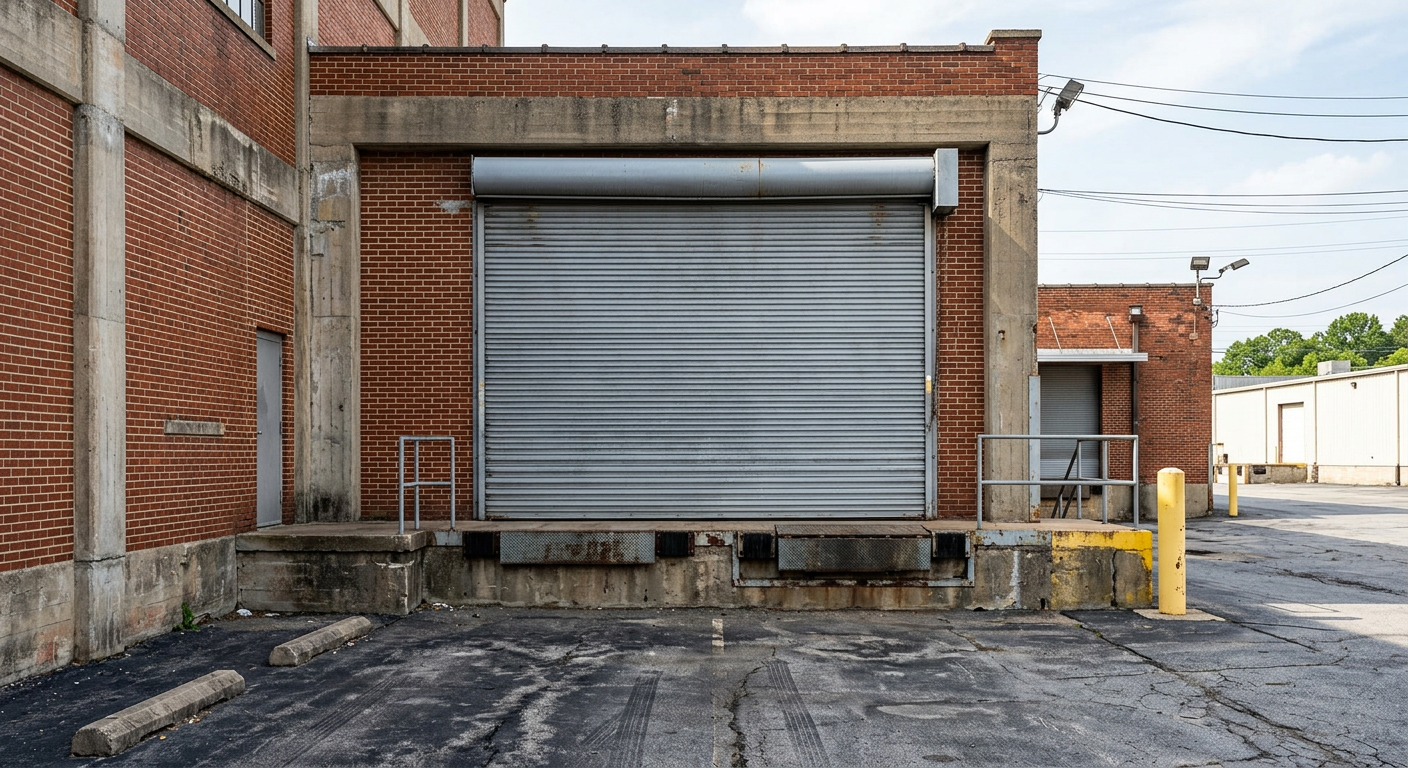
Rolling steel doors are the workhorses of warehouses, loading docks, fire stations, and industrial buildings across Indiana, Kentucky & Illinois. When one jams, binds, or refuses to roll, operations stop. We service every major rolling steel door type — slat curtain, insulated, fire-rated, and security grilles — with priority dispatch for commercial customers throughout Evansville, Newburgh, Henderson, and the broader Indiana, Kentucky & Illinois.
Who Needs This Service?
- Warehouses with rolling steel dock doors that won't open or close
- Fire stations with sluggish or jammed apparatus bay doors
- Self-storage facilities with damaged unit doors
- Industrial shops with bent slats from forklift impact
- Any commercial building where a rolling door has fallen off the barrel
What's Included
- Priority commercial dispatch
- On-site diagnosis with downtime estimate
- Curtain (slat) repair and panel replacement
- Barrel and drum service
- Spring tension adjustment and replacement
- Bottom bar and astragal repair
- Guide track straightening and replacement
- Written quote, COI on request
Our Process
- 1
Call 812-454-5711 — priority commercial dispatch, our team
- 2
On-site diagnosis with downtime and parts assessment
- 3
Written quote with fast-fix vs. complete repair options
- 4
Same-day or scheduled repair to protect operations
What This Service Costs
Final cost is provided in writing after a free on-site inspection. Actual pricing depends on door size, spring type, opener model, parts needed, and site access — so we don't publish flat rates online. We confirm scope, explain options, and get your approval before any work begins.
How a Rolling Steel Door Works
A rolling steel door is built from interlocking horizontal slats that coil around a steel barrel mounted above the opening. As the door opens, a torsion spring inside the barrel counterbalances the curtain's weight while the slats roll up and stack inside the barrel housing. Closing reverses the cycle — the curtain unrolls down the side guides until the bottom bar seats against the floor.
The barrel is the central axle and houses the counterbalance spring assembly. The springs are sized to the curtain's specific weight (slat gauge, height, width, insulation), so a 'spring' on a rolling steel door is not interchangeable with a residential garage door spring. Most issues — slow operation, doors that won't fully close, doors that drift — trace back to spring tension, barrel bearing wear, or guide alignment.
Operators (motorized) drive the barrel through a chain drive or direct drive coupling. When a motor runs but the door doesn't move, the failure is almost always in the chain, sprocket, or coupling — not the motor itself. Diagnosing rolling steel doors well means understanding the whole assembly, not just chasing the obvious symptom.
Common Brands We Service
We work on every major rolling steel door brand sold across Indiana, Kentucky & Illinois. Common parts for these manufacturers stay on the truck.
Cookson
Long-time commercial standard. Fire-rated and standard rolling steel — we keep common slats and springs for Cookson curtains in stock.
Cornell
Heavy-commercial rolling service doors and security grilles. Common at warehouses and retail.
Overhead Door (Pacific brand)
Widely installed nationally. We service the Pacific rolling line and source legacy parts when needed.
Wayne Dalton
Commercial rolling steel and rolling sheet doors. Common at light-industrial facilities.
Atlas Door
Commercial and high-cycle rolling doors. Warehouse and dock applications.
Janus International
Self-storage and light-commercial rolling steel. Quick part availability.
McKeon
Fire-rated rolling assemblies. Specialty service and NFPA 80 drop-test capability.
Common Rolling Steel Door Failure Modes
- Bent or impacted slats — usually forklift or vehicle impact at the bottom of the curtain. We replace damaged slats individually rather than the whole curtain when possible.
- Spring tension loss — barrel springs weaken over thousands of cycles. The door gets harder to lift manually and the operator strains. Re-tensioning or replacing the spring assembly resolves this.
- Curtain off the guides — common after impact or sudden release. The curtain pops out of one or both side guides. Re-threading the curtain and inspecting for slat damage is the typical fix.
- Bottom bar damage — the bottom bar seals against the floor and takes the most abuse. Bent or rusted bottom bars get replaced rather than repaired.
- Operator chain or coupling wear — motor runs but door barely moves. Chain stretch, sprocket wear, and coupling failure are the usual culprits at high-cycle commercial doors.
When to Repair vs. Replace
Most rolling steel door issues are economical to repair — slats, springs, bottom bars, and guides are all serviceable parts and we'd rather get you back in operation than push a replacement quote. A door with one damaged section and otherwise solid hardware is a clear repair.
Replacement starts to make sense when the curtain has accumulated multiple damaged slats across its height, when the barrel itself is damaged or the bearings are shot, when the door is non-code-compliant for its current use (e.g., fire separation now required), or when total repair costs over the next 12 months would approach 50%+ of replacement. We'll tell you straight when we see one of those situations rather than chasing endless repairs.
Talk to a real local technician — free written quote after on-site inspection.
Call 812-454-5711Why Indiana, Kentucky & Illinois Businesses Choose River City
Commercial customers don't have time for repair shops that 'might' come tomorrow. We prioritize commercial calls because we know what every hour of downtime costs your business. After-hours and weekend response is available across Indiana, Kentucky & Illinois for facilities that can't shut down during operating hours.